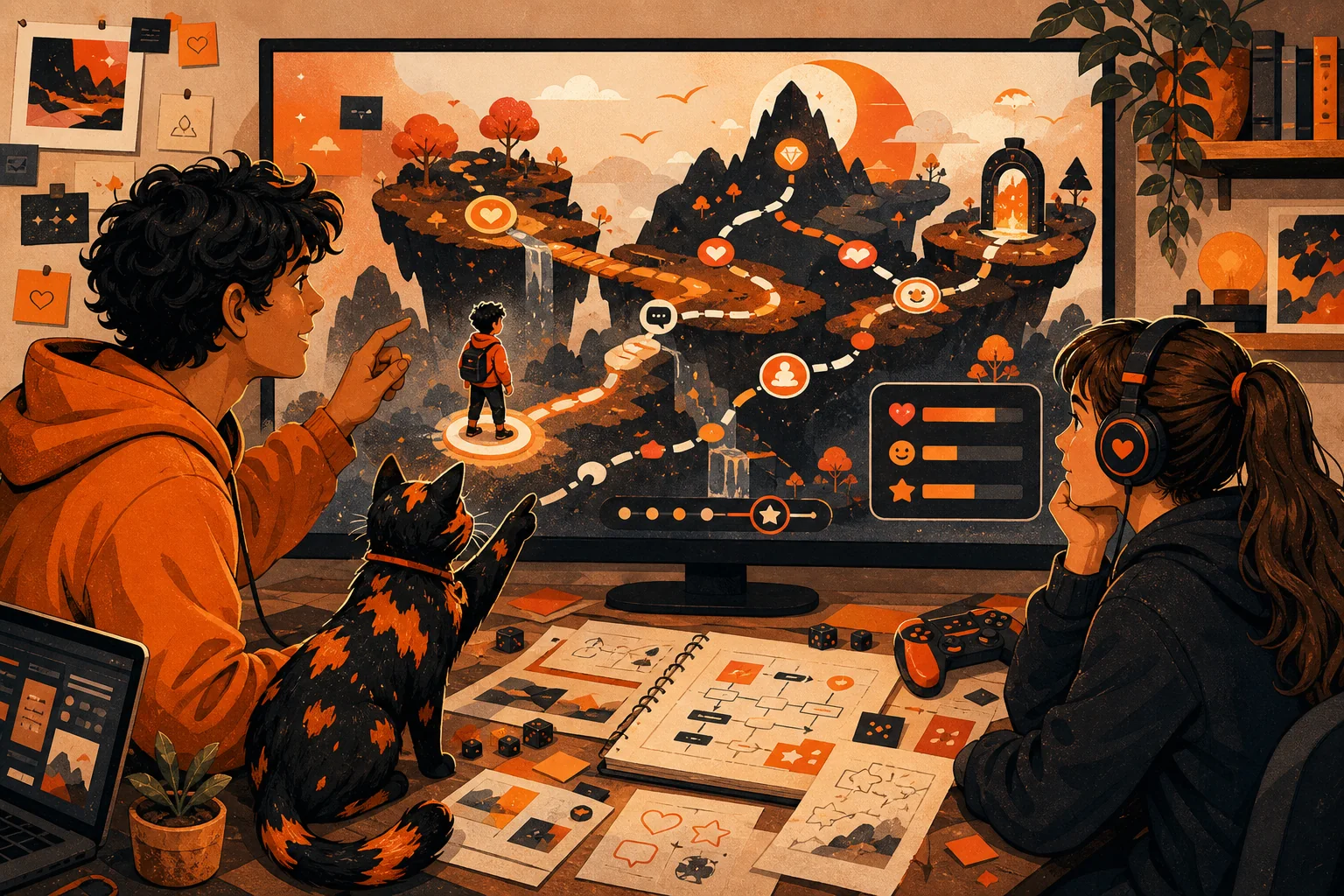
Educational gaming has emerged as a promising tool for mental health education and support. Research into serious games and gamified digital interventions suggests that well-designed experiences can increase engagement and create opportunities to practice useful skills.
The evidence is still developing, and games should not be treated as a universal solution or a replacement for qualified care. Their strength lies in making learning active, approachable, and repeatable.
Why Games Hold Attention
Games give players a clear goal, an understandable action, and feedback about what happened. That loop can make difficult or abstract topics feel more manageable.
- Agency: Players make choices rather than only receiving information.
- Feedback: Consequences help connect an action with an outcome.
- Progress: Small milestones make growth visible.
- Curiosity: Story and discovery provide a reason to continue.
These mechanics are useful only when they support the learning goal. Points and rewards alone do not guarantee meaningful engagement.
Interactive Learning and Retention
Reading about a coping strategy is different from deciding when to use it. An interactive scenario can ask a player to notice context, compare choices, and reflect on the result. Repeated practice can help ideas become easier to recall outside the game.
Educational games can also break complex concepts into smaller challenges. A player might first identify an emotion, then recognize a pattern, and finally choose among several responses.
A Lower-Pressure Space to Practice
Virtual environments can let players explore decisions without many of the real-world consequences associated with getting something wrong. A well-designed scenario makes room for experimentation, reflection, and another attempt.
- Encounter a challengeThe game presents a relatable situation with enough context to make a choice.
- Choose a responseThe player applies an idea rather than simply memorizing it.
- See the outcomeClear feedback connects the response to its possible effects.
- Reflect and retryThe experience encourages curiosity rather than shame.
Reaching Digital-Native Audiences
Games can meet young people in a medium they already understand. They may also offer flexible pacing, visual communication, and different ways to engage with information. Still, accessibility, privacy, age-appropriate design, and cultural relevance must be part of the design process from the beginning.
The most valuable game mechanic is not a score. It is a meaningful choice followed by feedback that helps the player understand themselves and the situation more clearly.
Designing Responsibly
Mental wellness games should communicate their limits clearly. They should avoid manipulative engagement patterns, protect player data, provide appropriate resource pathways, and involve relevant professional and community perspectives during development.
Games can open a door to learning and reflection. They work best as one part of a broader system of education, supportive relationships, and appropriate professional care.